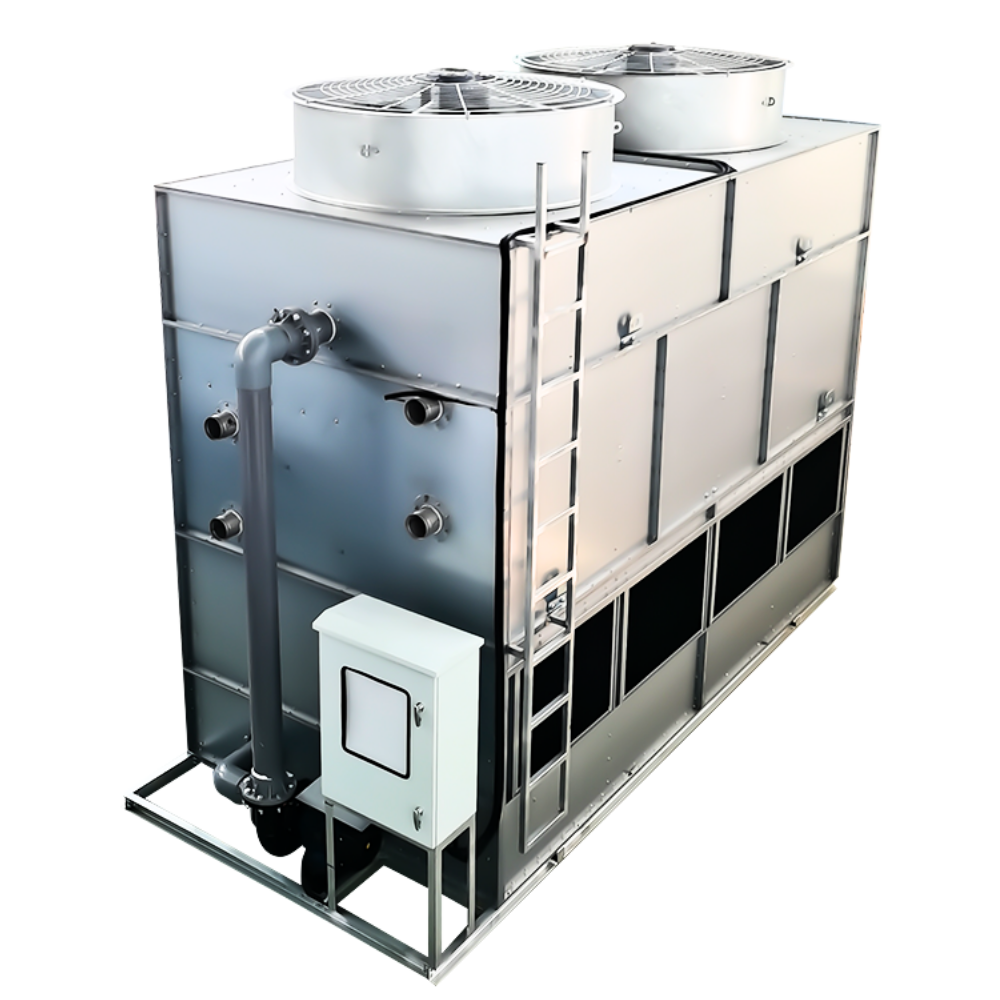
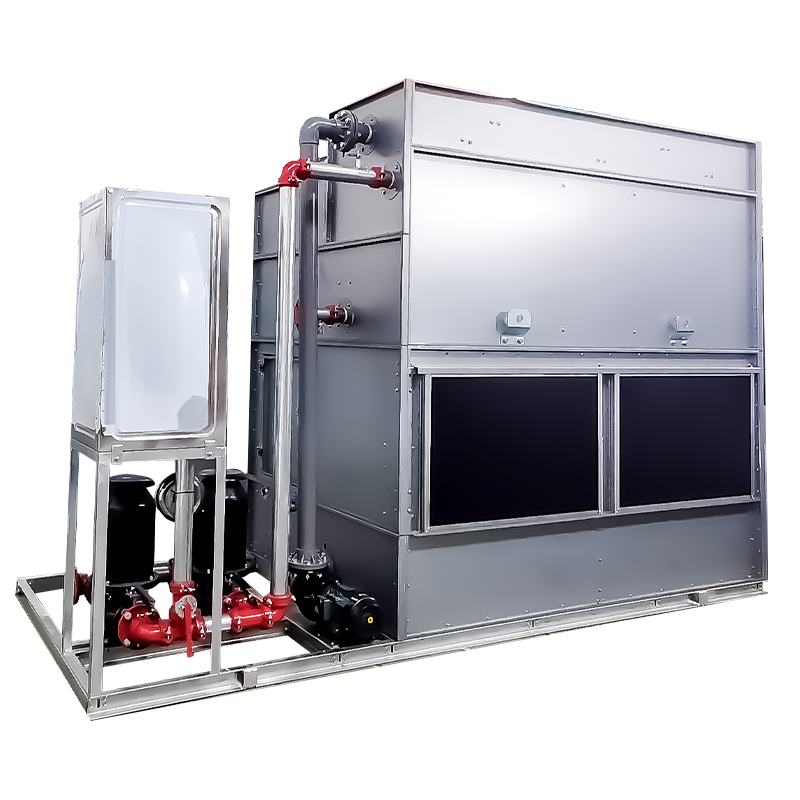
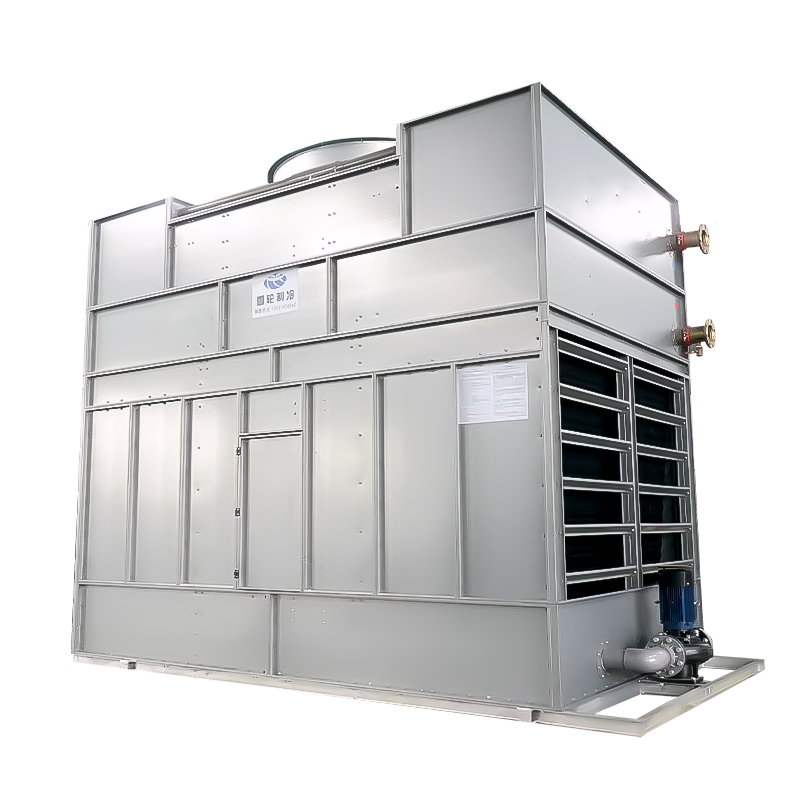
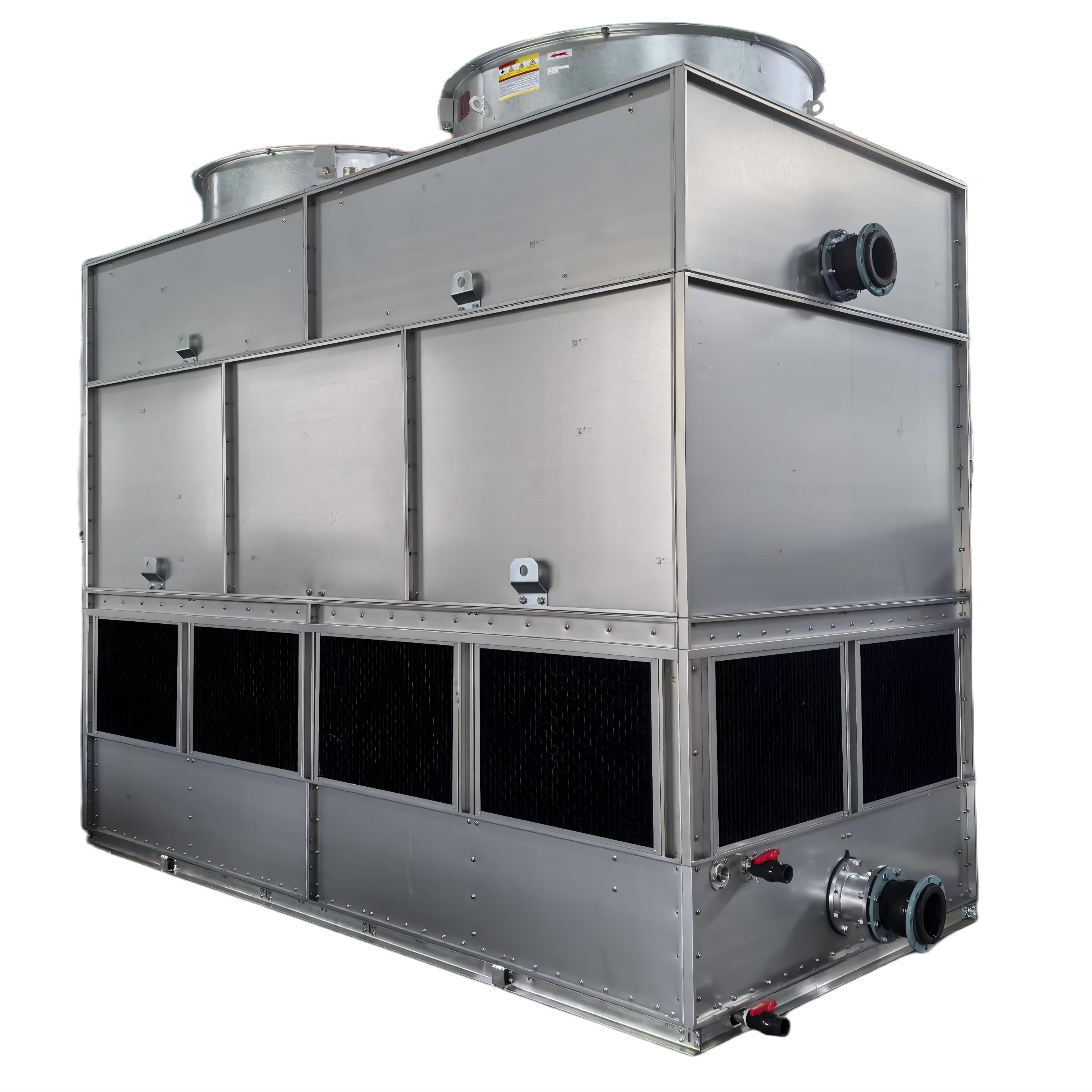
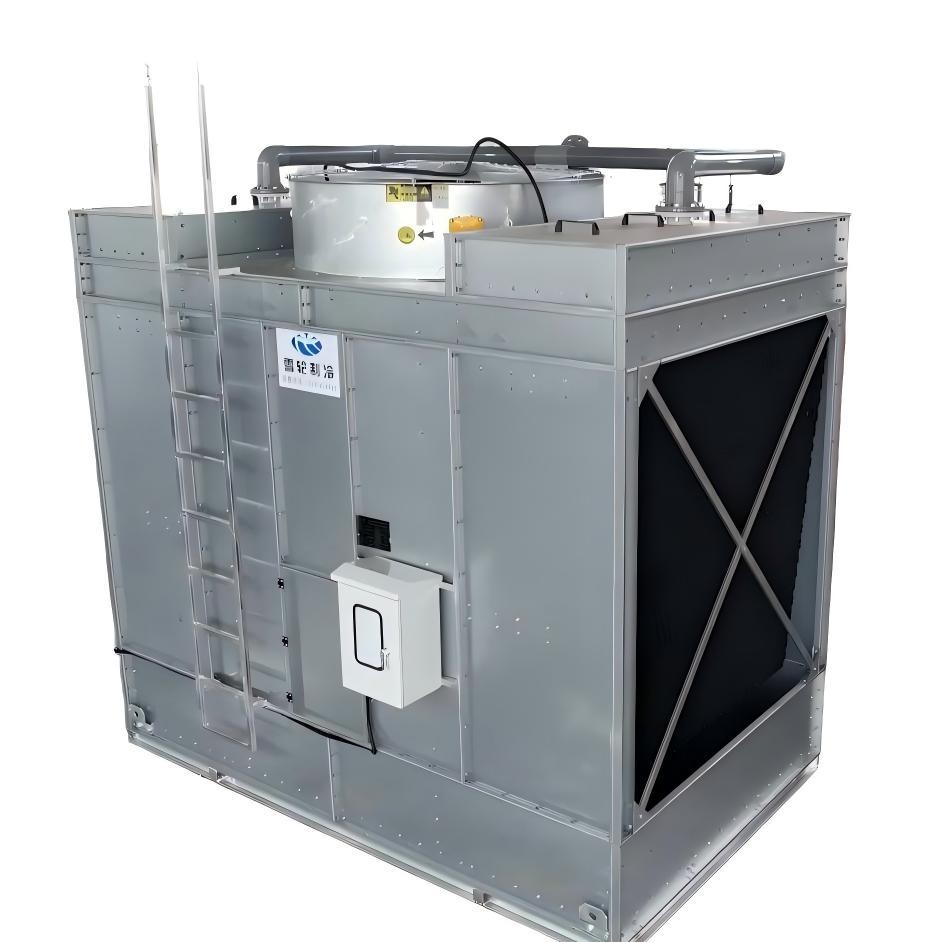
In industrial refrigeration and HVAC applications, closed-circuit cooling towers (also called evaporative fluid coolers) are becoming the preferred choice for many high-end projects, thanks to their superior water quality preservation and long-term operational stability. However, faced with different technical paths—counterflow, crossflow, hybrid flow—and complex variables such as materials, energy efficiency, and total cost of ownership, how do you make the best decision for your specific facility?
This article starts with the basic working principle and walks you through the entire selection process, helping you avoid common pitfalls and find the optimal solution that balances performance and economic benefit.
1. Fundamentals: How a Closed-Circuit Cooling Tower Works
Before selecting a model, it is essential to understand why closed-circuit cooling towers can simultaneously achieve “clean water” and “high-efficiency heat rejection.”
Inside a closed-circuit cooling tower, two completely independent circulation loops operate:
- Internal loop (closed circuit): The process fluid to be cooled (e.g., softened water, antifreeze, or certain chemical liquids) circulates inside sealed heat-exchanger coils, completely isolated from the outside air. It remains clean, contaminant‑free, and scale‑free at all times.
- External loop (spray/evaporation circuit): Spray water uniformly wets the outside surface of the coils, while a fan forcibly draws ambient air across them. Heat transfers from the process fluid inside the coils through the coil metal wall to the external water film, and is then released into the atmosphere through evaporative latent heat.
Core operating logic: Heat follows the path: process fluid → coil metal wall → spray water → evaporation to air. Because the internal and external loops never mix, closed‑circuit towers fundamentally eliminate the scaling, fouling, and bacterial growth problems that plague open cooling towers.
2. Step 1 in Selection: Accurately Characterize Your Cooling Duty
Any selection made without real data is guesswork. Before contacting suppliers, you need to define the following three core parameters:
- Heat load (heat rejection capacity): Usually measured in kW or BTU/h. This requires comprehensive calculation of equipment heat generation, flow rate, and specific heat capacity.
- Temperature range (inlet‑outlet temperature difference): Clearly specify the required inlet (hot end) and outlet (cold end) temperatures for your process equipment. For example, typical air‑compressor cooling might require 37 °C → 32 °C, while high‑temperature quench fluids may need to drop from 80 °C to 40 °C.
- Application characteristics: Is it a year‑round continuous operation data center, or a seasonal chemical production line? Is the installation space confined indoors, or in an open outdoor area?
3. Core of Selection: In‑Depth Comparison of the Three Main Closed‑Tower Designs
This is the most critical part of the selection process. Based on the airflow‑to‑water flow orientation, closed‑circuit cooling towers fall into three main types, each with its own technical emphasis.
2.1 Counterflow Closed‑Circuit Cooling Tower (High‑Efficiency Compact Type)
- Design: Air flows vertically upward (induced draft), while spray water flows vertically downward over the coils—the two move in opposite directions, creating countercurrent heat exchange.
- Key advantages:Highest thermodynamic efficiency: Cold air first contacts the coldest bottom coils, while warm air exits at the top after contacting the hottest spray water, maintaining a large temperature difference throughout and providing strong heat‑transfer driving force.Smallest footprint: Compact structure with vertical discharge, making it very friendly for sites with limited space.
- Best suited for:Indoor or workshop installations with space constraints (e.g., injection‑molding machines, compressor banks).Small‑to‑medium industrial equipment cooling where extreme temperature drops are not required (e.g., cooling to above 32 °C).Water‑source heat pump units and conventional air‑conditioning auxiliary cooling.
2.2 Crossflow Closed‑Circuit Cooling Tower (Maintenance‑Friendly Type)
- Design: Air flows horizontally across the coil and fill sections, while spray water falls vertically—the two directions intersect at 90°.
- Key advantages:Extremely convenient maintenance and inspection: Wide internal access allows personnel to easily enter the tower for cleaning fill and inspecting coils without complex disassembly.Lower achievable outlet temperature: With additional fill area increasing heat‑exchange surface, the outlet water temperature can be lower than that of counterflow towers, getting closer to the wet‑bulb temperature.Flexible modular expansion: Easy to add sections later as production capacity grows.
- Best suited for:Hot and humid southern regions, or demanding processes requiring very low outlet temperatures (e.g., cooling to below 28 °C).Facilities where frequent maintenance and high serviceability are required.Large central air‑conditioning systems with anticipated future capacity expansion.
2.3 Hybrid‑Flow (Combined‑Flow) Closed‑Circuit Cooling Tower (Energy‑Saving Flagship)
- Design: Combines the best of counterflow and crossflow technologies. Spray water first passes through a crossflow PVC fill section for pre‑cooling, then is sprayed onto the main counterflow or parallel‑connected coil heat‑exchange zone.
- Key advantages:Ultimate energy and water savings: Pre‑cooling the spray water significantly reduces the evaporation load on the coil surface, lowering total evaporation water consumption compared with pure counterflow towers, and substantially reducing coil scaling risk.Excellent performance under large temperature differences: Easily handles extreme cooling requirements like 80 °C → 30 °C with outstanding thermal stability.Environmentally friendly: Very low drift loss, meeting strict environmental emission standards.
- Best suited for:Rapid cooling of high‑temperature fluids (e.g., heat‑treatment quench oils, hot reactor jacket water).Water‑scarce regions and high‑end projects with strict energy‑ and water‑saving targets.Hard‑water or scaling‑prone environments in chemical or power plants, where protecting expensive copper or stainless‑steel coils is a priority.
4. Evaluation Dimensions: Materials, Energy Consumption, and Total Cost of Ownership (TCO)
After deciding on the structural type, assess specific product models from the following four perspectives:
4.1 Corrosion resistance of construction materials
Cooling towers operate in a persistently warm, humid environment, so material quality is critical.
- We recommend 304 stainless steel coils or copper coils (the latter offers superior thermal conductivity and better resistance to chloride corrosion, especially suitable for chemical applications).
- The casing should be made of aluminum‑zinc‑coated steel or steel with heavy‑duty anti‑corrosion coating, ensuring >10 years without rusting.
4.2 Energy efficiency (a major operating cost)
- Check whether high‑efficiency fan and permanent‑magnet synchronous motors are used.
- Variable‑frequency drive (VFD) capability is a strong plus: it automatically adjusts airflow according to ambient temperature and heat load, saving 20 %–40 % on annual electricity.
- Pay attention to drift loss rate—a high‑quality closed tower should have drift below 0.001 %, greatly reducing make‑up water costs.
4.3 Maintenance accessibility and parts commonality
Choose a tower with a well‑organized internal layout and wide access doors. Confirm that key components—fans, spray pumps, float valves—are standard commercially available parts, to avoid being locked into expensive non‑standard spare parts later.
4.4 Total cost of ownership (TCO) calculation traps
Do not compare only initial equipment investment! Be sure to account for:
- Civil works costs: Closed towers do not require a separate sump/pond; this saving can offset part of the equipment premium.
- Water and sewage fees: The water‑saving advantage of closed towers is significant; accumulated savings over 3–5 years can be substantial.
- Maintenance and downtime losses: Heat‑transfer degradation due to scaling, plus production losses from cleaning shutdowns, are often hidden “cost killers.”
5. Why Choose a Professional Partner? Xuelun’s Full‑Service Offering
Selecting a cooling tower is not just about screening equipment—it is also a test of the supplier’s technical capability. With years of deep experience in closed‑circuit cooling towers, Xuelun provides reliable support for your decision:
- In‑depth customisation: We not only prepare a cooling proposal based on your heat load, pipe diameters, and temperature data, but also send engineers for on‑site assessment of the actual installation environment—avoiding “paper‑only” planning and ensuring the solution perfectly matches your site conditions.
- Expert material recommendations: We offer targeted material advice for different industry pain points. For example, because chemical process fluids often contain corrosive components, we preferentially recommend copper heat‑exchange coils—their thermal conductivity is roughly eight times that of stainless steel, and they provide excellent corrosion resistance, greatly extending equipment life and improving cooling response. We are committed to using 100 % genuine, high‑quality materials and never substitute inferior products.
- Cost‑effectiveness and lifelong service: We strictly control costs across R&D, procurement, and production, delivering the best performance for the price and the best quality at the same price point. Beyond the standard one‑year warranty, we offer lifetime after‑sales service, with a 24‑hour rapid‑response commitment to resolve any operational issues promptly and keep your production running without interruption.
Conclusion
Choosing the right closed‑circuit cooling tower is essentially a precise balance among operating requirements, tower design, material quality, and service support. Whether you seek the extreme compactness of a counterflow tower, the maintenance convenience of a crossflow type, or the energy‑saving flagship hybrid‑flow design, the core principle remains the same: stay close to your real‑world conditions. Only with thorough data and on‑site assessment can you select the ideal cooling tower—one that meets today’s production needs while mitigating future risks.